
How to Choose a Custom Shower Tray Manufacturer - DAYA
2026-09-09
Who this guide is for: distributors, bathroom brands, contractors and hospitality fit-out teams evaluating a custom shower tray manufacturer. If you are a homeowner with one unusual recess, the maths is different — start with our shower tray sizes guide instead, because a standard format will almost always beat custom on lead time.
For everyone else — a project that standard trays can't cover, a brand that needs its own dimensions, or a hotel programme with a fixed waste position — "custom" is not a product, it's a relationship with a factory. And like any relationship, the cheapest time to find out you chose wrong is before the deposit, not after container 3 arrives warped. This checklist condenses the seven things procurement teams should verify before signing, drawn from what we see on the factory floor every week.
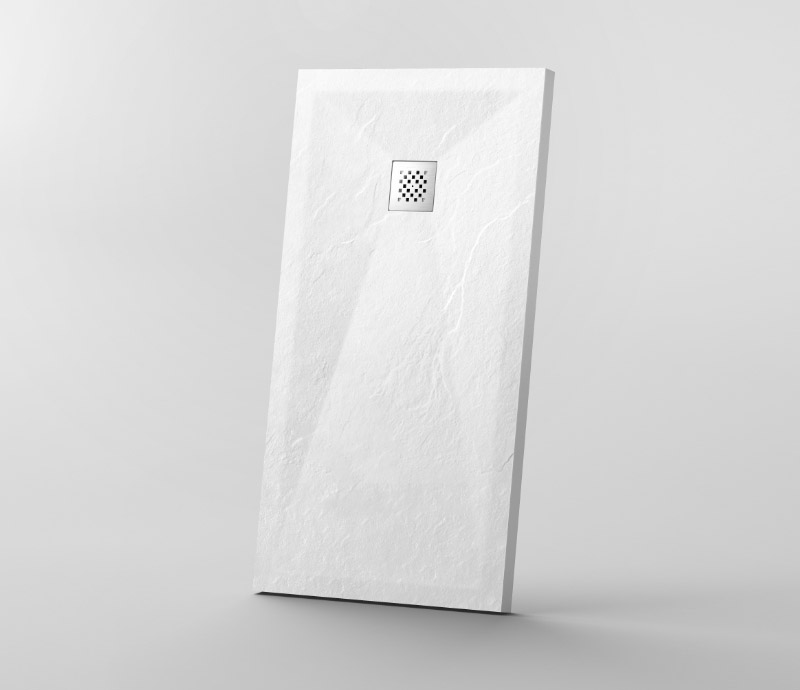
1. Custom vs Standard: Which Projects Actually Need It
Custom manufacturing earns its complexity in four situations. Outside these, standard is usually the smarter buy.
1. The recess is off-standard. Attic conversions with sloping walls, heritage buildings where walls lean 3 cm over two metres, or premium apartments with design-driven geometries. If your recess isn't within 2 cm of a catalogue size — and our standard matrix runs from 70 cm to 2000 mm — measurement drift will haunt every unit you install.
2. The waste position is immovable. Hotel retrofits and slab-built apartments where re-routing drainage costs more than the tray. When the outlet sits 24 cm from the wall at a specific offset, you need a tray drilled to the pipe, not a pipe bent to the tray.
3. The brand needs its own footprint. Distributors building a private-label range: unique dimensions create a defensible catalogue. If your tray is identical to forty others, buyers comparison-shop on price alone.
4. Volume justifies tooling. A project needing 200 units of the same unusual size amortises mould cost into a per-unit price that can rival stock. A single unit never will — which is why minimum order quantities exist (more on ours in Section 5).
The honest inverse: if your project fits a standard size, take the standard. It ships faster, costs less, and its dimensional data is already field-proven across hundreds of installations.
1.1 Where the cost curves cross
The per-unit economics of custom versus standard follow a predictable crossover. Custom carries two fixed costs — tooling and the sample round — that standard never sees. Divide those fixed costs by your planned volume, add the per-unit production price, and compare against the stock price. Below roughly 20–30 units, standard nearly always wins; between 50 and 200 units, the curves cross somewhere that depends on how far off-standard your dimension is; beyond that, custom frequently wins outright because you've stopped paying a distributor margin on someone else's catalogue number. There is a second dividend the spreadsheet misses: owning the dimension means nobody undercuts your listing with an identical product at 90% of your price. For private-label ranges, that pricing power routinely outweighs the tooling bill within the first season.
2. The 7-Point Manufacturer Checklist
Run every candidate factory through these seven gates. A serious manufacturer answers all seven in writing; hesitation on any one of them is data.
2.1 Production capacity you can verify
Ask for monthly output in units, factory floor area, and how many production lines run your product category. Then cross-check: does the number of lines plausibly support the claimed volume? Our own numbers are published because they survive scrutiny: 24,000 pieces per month across two factories — Shantou, Guangdong (HQ) and Huai'an, Jiangsu — on 48,000 m² with 23 years in the trade and exports to 60 countries. Capacity matters for one reason: your Q4 replenishment order is someone else's Q4 too, and a factory at 95% utilisation pushes your container to make room for a bigger buyer.
Red flag: output quoted in "containers per year" with no unit count, or a floor area that triples between the website and the sales deck.
2.2 Material formulation transparency
"Stone resin" covers a wide spectrum. Ask what the composite actually is. Our formulation is 72% calcium carbonate and 21% unsaturated polyester resin by mass, finished with a gelcoat surface layer — and we publish it because the ratios determine the two properties that matter in service: dimensional stability (a tray that doesn't flex or crack at 1200 mm+ spans) and surface longevity (no yellowing, easy cleaning). A supplier who can't state their ratios is buying them from someone else.
Red flag: a datasheet that lists "stone resin" without ratios, or one that changes ratios between the catalogue and the quotation.
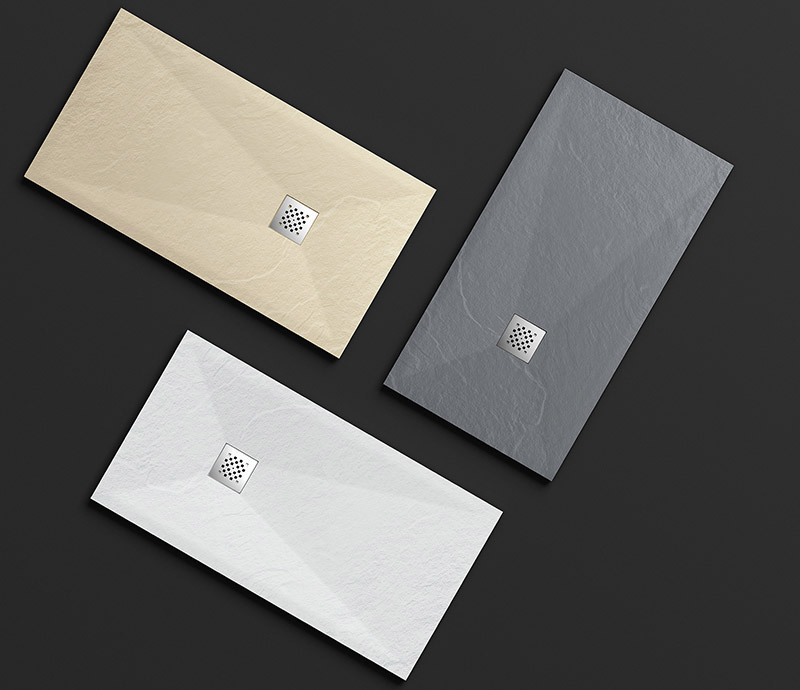
2.3 Mould ownership and tooling policy
This is the clause most first-time buyers skip and most veterans negotiate hardest. Questions, in order: Who owns the mould once it's paid for? Is your dimension exclusive to you, or will the factory quote your competitor the same shape next quarter? What is the tooling cost, and at what order volume is it amortised? Get the answers in the contract, not in the sales rep's confidence. A factory with its own mould-making operation — as we run, as step two of our custom flow — shortens iteration loops because design changes don't queue behind a third party.
Red flag: "we'll sort ownership out after production" — tooling terms fixed after the mould exists means you have none.
2.4 Dimensional tolerance and QC process
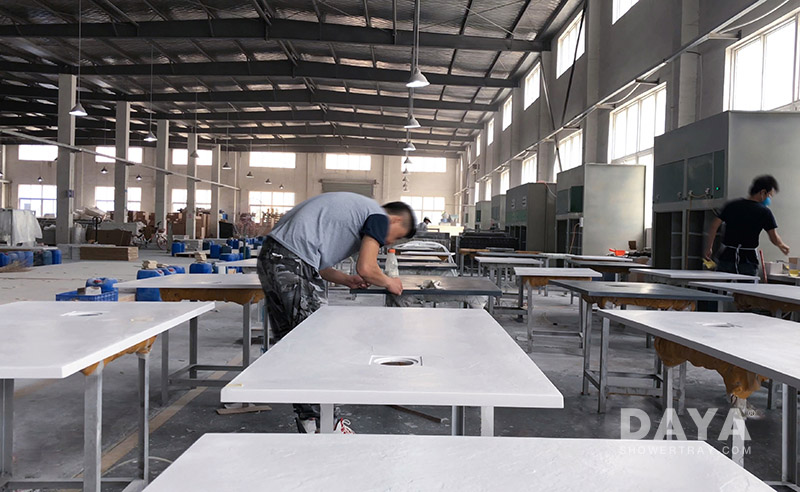
Ask two things: the tolerance you'll get (in millimetres, on length, width, and flatness), and how it's checked. Our process runs seven steps — mould preparation and release coating, gelcoat spraying into the industrial oven, resin injection, trimming, polishing and waxing, a dedicated deformation inspection at QC, then packaging — and the inspection step exists precisely because a stone resin tray fresh off the line can warp if the cure schedule is wrong. A flatness tolerance and a documented inspection point are your insurance that the 1400 × 900 tray lays dead-flat on the mortar bed.
Red flag: QC described as "our workers check everything" with no inspection step you can name, photograph, or audit.
2.5 Sample policy before bulk
A pre-production sample is not a courtesy; it's a test protocol. Verify: does the sample come from the production mould (not a 3D-printed mock-up)? Can you test-fit it against your enclosure and waste rough-in? What does re-tooling cost if the sample reveals an error? One round of physical fitment routinely catches what drawings miss — drain position off by 15 mm, an edge profile that fights the glass channel, a lip that traps water against the tile line.
Red flag: samples quoted from a different mould than bulk, or "sample fees" that vanish from the contract but reappear on the invoice.
2.6 Branding and white-label capability
For private-label programmes, check the OEM toolkit before you need it: printed cartons with your logo, laser-etched logos on the tray surface, custom label design (files accepted in AI/PSD/PDF/JPG/PNG), and customised installation manuals built from templates. Branding capability is also a proxy for maturity — a factory that routinely white-labels for other brands already operates to the documentation and consistency standards your market will demand.
Red flag: branding limited to a sticker, or artwork files requested in formats no designer has used this decade.
2.7 After-sales and installation support
The sale ends at the dock; the project doesn't. Ask what follows the tray: customised installation manuals, video guidance for installation and repair, and a marketing asset pack (we supply 10 product shots plus 10 scene renders per series, so your catalogue launches the week your container lands). And ask who answers when a fitter calls with a question in week 40 — the answer is a decent proxy for how the whole company is run.
Red flag: a support email that routes to the sales agent who answered first, with no named owner after shipment.
3. The DAYA Custom Flow: Drawing to Sample in Three Steps
Every custom order runs the same three-step flow, refined over 23 years of OEM work.
Step 1 — Refined drawings. You supply dimensioned drawings (sketch quality is fine to start; CAD is faster). We confirm manufacturability: draft angles, waste position against the fall geometry, edge build-ups, and the thickness call — 2.5 cm for retrofit height limits or 3 cm for added stiffness on longer spans. This is where 80% of future problems are cheapest to kill.
Step 2 — Mould making. We cut the mould in-house. Ownership terms per Section 2.3 are fixed here, in writing. In-house tooling matters more than it sounds: design tweaks cycle in days rather than routing through an external toolmaker's queue.
Step 3 — Sample approval. A production-mould sample for your fitment test — against the real enclosure, the real waste rough-in, the real site conditions. Approve it, and bulk production schedules into the line; request changes, and the in-house loop repeats. Bulk runs then carry the full seven-step QC, ending in deformation inspection before packing into your printed cartons.
What you should prepare in parallel — because the factory's clock runs fastest when your side doesn't stall it. During drawings: nominate one decision-maker with authority over dimensions and branding, and collect your artwork files early (label artwork, logo vector, carton print spec — AI/PSD/PDF/JPG/PNG all workable). During sampling: book the fitter and the site for the fitment test before the sample ships, so evaluation happens in days rather than sliding across calendars. During bulk: agree your inspection window — whether that's your own team's video call at packing, a third-party inspector's visit, or photo documentation of the container loading. Buyers who parallel-track these steps routinely cut weeks off the calendar without touching a single production variable.
4. The OEM Service Stack (What Ships with the Trays)
The tray is the product; the stack is what makes it sellable in your market. Every DAYA series ships with the option of:
- Printed packaging — cartons in your brand, not ours
- Laser-etched branding — your logo onto the tray surface itself
- Custom labels & manuals — label artwork from your AI/PSD/PDF/JPG/PNG files; installation manuals customised from our templates
- Video support — installation and repair guidance footage for your support team and end customers
- Launch asset pack — 10 product photographs and 10 scene renders per series, so the product page can go live the week stock arrives
For wholesale buyers, this stack is the difference between "we bought trays" and "we launched a line." For our side, it's routine — the OEM infrastructure exists because 60 countries' worth of partners keep using it. And the stack rides on a disciplined product base: every series — from the flagship Series F to the marble-veined Series Marble L — carries the same size matrix and the same composite, so your brand line stays coherent as it grows.
5. MOQ and Lead Time: Planning the Honest Numbers
Minimum order quantity: 18 pieces. We publish the number because it surprises people on both ends — high enough that we're not a sample shop, low enough that a regional distributor or a 20-room hotel programme can justify a custom dimension. At 18 units, a custom tool amortises into a workable per-unit price on mid-size projects; at container volumes, it disappears into rounding.
Lead time has three components, and honest suppliers quote all three: mould cutting (measured in days when tooling is in-house), the sample round (shipping time to you plus your evaluation window — budget a week for a serious fitment test), and bulk production scheduled against the factory's live capacity. Two plants and 24,000 pieces a month of throughput is what keeps that third component predictable across Q3 promotions and pre-holiday rushes alike. Exact dates come from the quote process — drawings in, schedule out; no estimate survives contact with a real drawing anyway.
5.1 Packaging and freight: the part that eats margins quietly
A stone resin tray is heavy, rigid, and surprisingly vulnerable in exactly one direction: a point load across an edge. Freight damage claims in this category trace back to packaging decisions made before the pallet was built, so put packaging on the agenda while you're still quoting. Ask any supplier exactly how trays are protected for freight: foam and corner boards inside export-grade cartons — which for OEM clients you can have printed in your own brand? Trays seated edge-on rather than face-down? Stacking limits marked on the carton rather than assumed? Three more questions that cost nothing and settle most "arrived broken" disputes before they start: what's the drop-test history of this carton spec, what's the container loading plan (trays vertical on A-frames or flat on pallets), and who photographs the loaded container before the doors are sealed.
5.2 Verifying the factory when you can't fly there
Full audit attendance isn't always possible, but distance is no excuse for skipping verification — it just changes the method. A structured video walk-through beats a polished showroom tour: ask the supplier to film live, starting at the receiving dock and ending at the loading bay, with your questions asked in real time ("show me where the gelcoat is sprayed," "pan across the QC bench now"). Production metrics should arrive as system screenshots with dates, not brochures. Third-party inspection services will run an on-site check for a few hundred dollars — money that is trivially justified the moment a custom tool is involved. And request one reference customer in your own region who runs a comparable programme; a manufacturer with 60 export markets can produce one. What you're verifying is consistency, not perfection: a factory that shows you the real floor, real numbers and a real reference is telling you how the next three years of emails will go.
6. FAQ
What is a realistic minimum order for a custom shower tray? Ours is 18 pieces — deliberately low so mid-size fit-outs and regional distributors can access custom dimensions. Below that volume, the honest advice is to check the standard size matrix first; above it, custom per-unit pricing becomes increasingly competitive with stock.
How long does a custom shower tray take from drawing to delivery? Three stages: mould cutting, one sample round (including your fitment testing window), then bulk production. In-house tooling compresses the first stage; bulk timing depends on the live production calendar. Send drawings through the quote page for a schedule against your quantities.
Who owns the mould after it's paid for? Whatever your contract says — which is why Section 2.3 tells you to make it say something explicit. We fix ownership and exclusivity terms in writing before tooling begins; every serious manufacturer will do the same, and hesitation here is a signal.
Can you produce trays in our brand with our packaging? Yes — printed cartons, laser-etched logos, custom labels (AI/PSD/PDF/JPG/PNG), templated installation manuals, and per-series asset packs (10 product shots + 10 renders). White-label is a standard workflow, not a special favour.
What material are the custom trays made from? The same stone resin composite as our catalogue: 72% calcium carbonate, 21% unsaturated polyester resin, gelcoat finish — cast in one piece, non-porous, anti-slip and antibacterial by formulation, and dimensionally stable at spans where thinner materials flex.
Do you support installation after delivery? Customised installation manuals (from templates), installation and repair video guidance, and responsive support through the project window. The tray should outlast the tiling around it; our support is built for the same horizon.