
Shower Tray Sizes: Complete Guide & Size Chart | DAYA
2026-09-09
How to use this guide: if you are comparing standard shower tray sizes for a new bathroom, jump straight to the size chart in Section 3. If you already know your footprint, the DAYA quick-reference chart in Section 5 maps every series we manufacture from 700 mm compact enclosures up to a 2000 mm shower tray for full wet-room layouts.
Choosing a shower enclosure is the fun part of a bathroom project. Choosing the tray it stands on is the part that decides whether everything fits, drains properly, and passes inspection. Get the shower tray size wrong by even 20 mm and you are into re-tiling, re-plumbing, or shimming a tray that was never designed for the gap. This guide walks through the standard dimensions that dominate the market, a repeatable way to measure your space, and the actual size matrix behind all 17+ DAYA series — so you can shortlist confidently before you request a quote.
1. Why the Right Shower Tray Size Matters
A shower tray does three jobs at once, and size affects all of them.
Water containment. A tray that is too small for the spray pattern of your enclosure lets water escape at the door line. A tray that is much larger than the enclosure wastes floor space and creates a cold, unused margin of stone resin that only collects dust and soap film.
Drainage geometry. The position of the waste — centre, corner, or linear — must line up with your existing pipework. Trays from 900 × 900 mm and above usually offer enough internal fall area for a comfortable corner waste, while compact 70–80 cm formats are typically drilled for a single positioned waste to maximise the flat standing area.
Floor loading and build height. Stone resin trays carry real weight: a 2000 mm shower tray in 3 cm-thick composite is a two-person install and needs a level, reinforced substrate. Knowing the exact size and thickness before ordering avoids the classic retrofit problem of a tray that sits proud of the finished floor line.
There is also a compliance dimension. In many European markets, accessibility guidelines recommend a low-profile or level-access entry of 25 mm or less. Thickness options of 2.5 cm and 3 cm — standard across the DAYA range — sit naturally in that zone, which is why the size chart below lists thickness alongside footprint.
2. Standard Shower Tray Sizes: The Market Panorama
Walk into any bathroom retailer in the UK, EU, or North America and you will meet the same core formats. Here is the panorama in metric — the language every European bathroom is measured in.
2.1 Square trays
| Metric (mm) | Typical use |
|---|---|
| 800 × 800 | Compact en-suites, cloakrooms |
| 900 × 900 | The volume seller — fits almost every alcove |
| 1000 × 1000 | Comfortable single shower |
The 90x90 shower tray deserves its reputation: it matches the standard 900 mm enclosure module that most enclosure brands build around, and it is the single most-searched square format in the category. (Category-wide search data confirms it — "90x90" and "900 mm" variants dominate square-format queries in most English-speaking markets, which keeps availability high and prices competitive.)
2.2 Rectangular trays
| Metric (mm) | Typical use |
|---|---|
| 800 × 700 | Narrow recesses |
| 900 × 700 / 900 × 800 | Small bathrooms with a length bias |
| 1000 × 700 / 1000 × 800 / 1000 × 900 | Gallery-layout bathrooms |
| 1200 × 700 / 1200 × 800 / 1200 × 900 | The classic "large shower" rectangle |
| 1400 × 900 | Double-ish showering in one direction |
| 1600 × 800 / 1700 × 700 / 1800 × 800 | Wet-zone walls, walk-in layouts |
| 2000 × 1000 | Full wet rooms, shared showers |
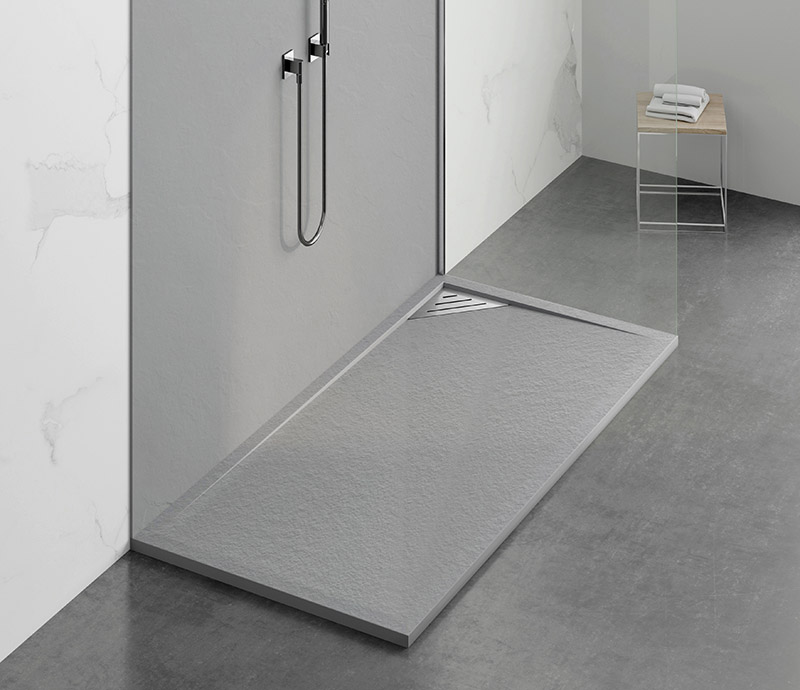
The 2000 mm shower tray segment is small in unit volume but disproportionately visible in search: it is the format architects specify for level-access wet rooms and family bathrooms where two fixtures share one wet zone. Manufacturing a true 2-metre one-piece tray in stone resin without warping is a genuine technical barrier — it is why many brands stop at 1800 mm and why our catalogue runs the full range to 200 × 100 cm (more on that in Section 5).
2.3 Quadrant and offset quadrant
| Metric (mm) | Typical use |
|---|---|
| 800 × 800 Q / 900 × 900 Q | Corner installs, sliding doors |
| 1000 × 800 offset | One-sided corner allocation |
| 1200 × 900 offset | Larger corner wet zones |
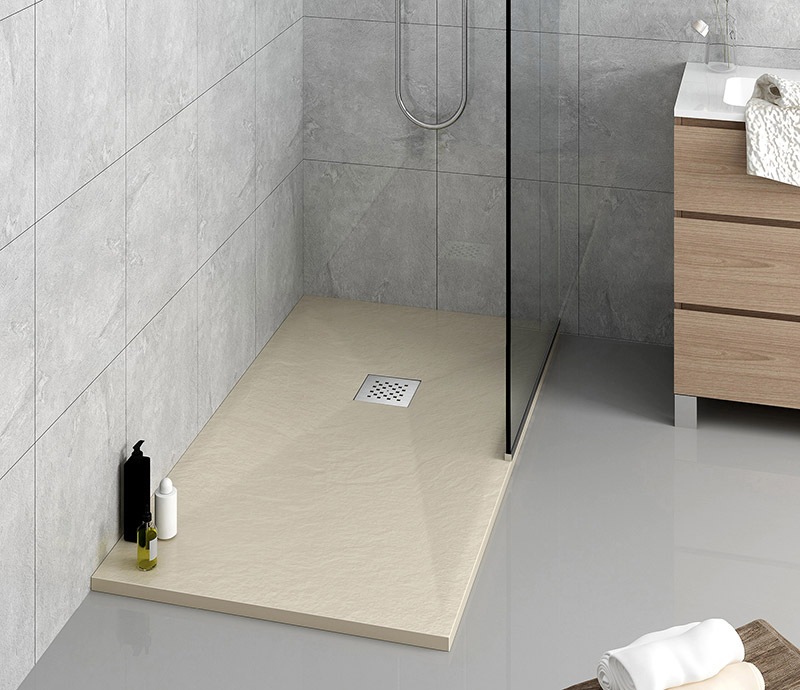
Quadrants trade internal standing area for a smaller floor footprint — the curved front gives elbow room at the door swing. Offset quadrants suit bathrooms where one wall is longer than the other.
2.4 Octant / pentangle
| Metric (mm) | Typical use |
|---|---|
| 900 × 900 octant | Corner entry with door clearance |
| 1000 × 1000 pentangle | Neo-corner layouts |
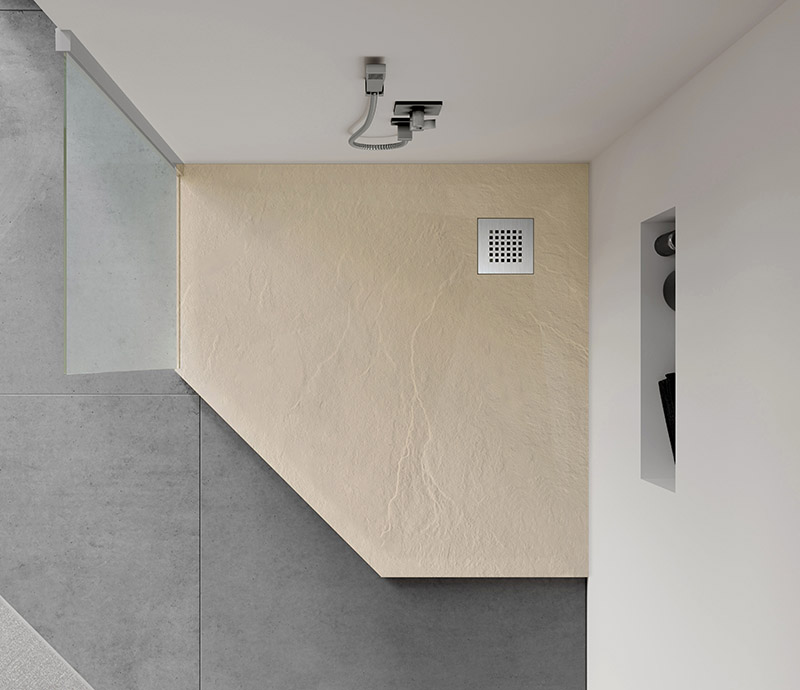
Five-sided trays solve a specific problem: corner entry doors that need somewhere to slide. They remain a steady niche format across EU markets.
3. How to Measure Your Bathroom in 3 Steps
Sizes only matter in relation to your actual recess. Here is the measuring sequence our OEM partners' installation teams use.
Step 1 — Measure the recess, not the old tray. Remove skirting assumptions and measure wall-to-wall at three heights (floor, 20 cm, 90 cm). New builds are rarely square; older bathrooms even less so. Record the smallest of the three widths — the tray must pass the narrowest point.
Step 2 — Fix the waste position before the tray model. Measure from the finished wall to the centre of the existing waste outlet, in both directions. If you are keeping the pipework: your shortlist is now "trays whose waste can be drilled at X cm from the long wall and Y cm from the short wall." If you are re-plumbing anyway, note it — your options open up to centre-waste formats which are cheaper and drain faster.
Step 3 — Subtract the tolerance triangle. Professional fitters allow: 5 mm installation tolerance per wall, 10–15 mm for the enclosure profile that sits on the tray, and 2–3 mm sealant lines. On a 900 mm recess that means the comfortable maximum tray is 880–890 mm — which is exactly why ordering "one size down" from the measured gap is the standing advice. Write your three numbers down; every series in the chart below can be checked against them in seconds.
One more measurement that gets skipped: the door swing and entry width. A 900 × 900 tray with a sliding enclosure needs zero swing clearance; with a hinged door it needs 60–70 cm of clear floor in front. Measure it once, save a return.
4. Thickness, Fall and Material — What the Numbers Mean with the Size
Two trays with identical footprints can behave very differently.
- Thickness: 2.5 cm vs 3 cm. Both are low-profile by EU accessibility standards. The 2.5 cm format suits retrofit projects where every millimetre of build-up counts; the 3 cm format gives a marginally stiffer feel on wider spans (anything above 1400 mm length appreciates the extra rigidity).
- The fall you don't see. Stone resin trays are cast with a manufactured fall of roughly 1–2% toward the waste. On larger formats — the 1800–2000 mm class — the fall is engineered so that water travels no more than ~50 cm laterally, which is why linear-drain layouts dominate that segment.
- Why material pairs with size. A composite tray at 72% calcium carbonate and 21% unsaturated polyester resin (the DAYA formulation, verified from our own production specification) holds dimension over decades without the flex that thinner acrylic-capped steel shows at 1200 mm and beyond. At the 2000 mm end of the chart, material choice stops being a preference and becomes a requirement.
5. DAYA Series Size Quick-Reference Chart (17+ Series)
This is the module that most size guides skip: the actual size matrix of one manufacturer's full range. Every DAYA shower tray series below is cast in the same stone resin composite, in your choice of five colours (White, Beige, Light Gray, Dark Gray, Black), with thickness options of 2.5 cm or 3 cm.
5.1 Metric width series (cm-based, the EU wet-room workhorses)
Each width is available in multiple length variants — typically +70, +80, +90 and +100 cm — so a "140" width class covers 140 × 70, 140 × 80, 140 × 90 and 140 × 100 cm trays.
| Width class | Length variants | Example formats |
|---|---|---|
| 70 cm | 70 | 70 × 70 |
| 72 cm | 70 / 72 / 90* | 72 × 90 corner-friendly |
| 80 cm | 70 / 80 / 90 | 80 × 80 |
| 90 cm | 70 / 72 / 80 / 90 | 90 × 90 volume format |
| 100 cm | 70 / 80 / 90 / 100 | 100 × 100 |
| 110 cm | 70 / 80 / 90 | 110 × 80 |
| 120 cm | 70 / 80 / 90 / 100 | 120 × 90 classic |
| 130 cm | 70 / 80 / 90 | 130 × 90 |
| 140 cm | 70 / 80 / 90 / 100 | 140 × 90 double-ended |
| 150 cm | 70 / 80 / 90 / 100 | 150 × 90 walk-in |
| 160 cm | 70 / 80 / 90 / 100 | 160 × 80 wet-zone |
| 170 cm | 70 / 80 / 90 | 170 × 70 wall-hugger |
| 180 cm | 70 / 80 / 90 / 100 | 180 × 80 |
| 190 cm | 70 / 80 / 90 | 190 × 90 |
| 200 cm | 70 / 80 / 90 / 100 | 2000 × 1000 mm flagship |
* Exact length availability per width class varies by series and mould; the full model code list is confirmed on quotation.
Beyond the 15 metric width classes, the range includes two marble-texture series — Series Marble F and Series Marble L — which carry the same size matrix with a Calacatta and marble-vein surface line for feature-bathroom specs.
5.3 Which series for which project?
The honest answer: the size matrix is shared, so series choice is a design decision — drain position, edge profile, and surface texture — rather than a size decision. That is deliberate. It means once you have measured your recess (Section 3), every series in the list is a live option, and you can shortlist on looks and drainage instead. Browse Series F (the flagship flat profile), Series I (compact-confidence favourite) and the marble lines above to feel the range, or see the full shower tray catalogue.
5.2 Three formats, three decisions: reading the matrix in practice
Charts are reference; projects are decisions. Three formats from the matrix above cover most real briefs we see, and each rewards a different kind of thinking.
The 90 × 90 cm square is the default answer for a reason. It clears the door swing of a standard 700 mm hinged enclosure, accepts a centre waste on most floor plans, and — because every enclosure brand builds a 900 mm module — your tray never locks you into one glass supplier. If the bathroom is tight but not unusual, start here and talk yourself out of it only with measurements, not vibes.
The 140 × 90 cm rectangle is where showering starts to feel generous rather than adequate. It fits two bathing modes (fast weekday rinse facing the wall, unhurried weekend wash with the handheld), and its length runs along the long wall of most European family bathrooms without eating the circulation corridor. Choose the drain position early on this format: at 140 cm, a corner waste keeps the standing zone fully flat, which guests notice even if they never articulate it.
The 2000 × 1000 mm flagship is a different project, not just a bigger tray. It presumes a wet-room build: a sloped or recessed substrate, a linear drain strategy, and glass that runs wall-to-wall. Done right, it is the single most photogenic thing in a property listing; done without planning, it is the most expensive paddling pool in town. Verify floor build-up depth and waste run-off direction before you fall in love with it — and note that at this footprint, one-piece casting stops being a luxury and becomes your leak insurance.
Everything between and beyond these three follows the same logic: measure the recess (Section 3), respect the tolerance triangle, then let the matrix — not a salesperson — narrow the field.
6. Custom Shower Tray Sizes: When Standard Isn't Enough
Roughly one project in ten does not fit any chart — attic conversions with tapering walls, heritage bathrooms with off-square recesses, hotel retrofits where the existing waste must be kept at all costs. That is custom territory, and it is a normal order for us rather than an exception.
A few facts make custom less daunting than it sounds. Our production floor runs 24,000 pieces per month across two factories (Shantou, Guangdong and Huai'an, Jiangsu), so a custom mould slot is a scheduling exercise, not a miracle. The standard flow is three steps: you send refined drawings, we cut the mould, you approve the sample — with a minimum order quantity of 18 pieces that keeps custom viable for mid-size fit-outs, not just hotel chains. For the full checklist of what to verify before commissioning a custom tray — mould ownership, tolerance guarantees, packaging specs — read our custom shower tray manufacturer guide.
If your project sits in the 90 × 90 to 120 × 90 window, try standard first — the chart above probably already contains your size, and the lead time will thank you. Below 800 mm or above 2000 mm, or anywhere the walls aren't square: go custom from the start.
7. FAQ
What is the most popular shower tray size? The 900 × 900 mm square is the category's volume format — it matches the standard 900 mm enclosure module. In our export range, the 90 cm width class and the 100 × 100 cm square consistently lead order volumes.
What is the standard shower tray size in cm? There is no single standard, but the market converges on: 80 × 80, 90 × 90 and 100 × 100 cm squares; 120 × 80 and 120 × 90 cm rectangles; and 800/900/1000 mm quadrants. Our metric series covers widths from 70 to 200 cm in 15 width classes, so the "standard" sizes are all in-production formats rather than special orders.
Does a 2000 mm shower tray exist in one piece? Yes. Our largest standard format is 2000 × 1000 mm, cast one-piece in stone resin at 2.5 or 3 cm thickness. One-piece matters at this size: jointed trays rely on site sealing across a 2-metre span, which is the most common leak path in large wet rooms.
How much smaller should the tray be than the enclosure? The enclosure sits on the tray, not inside it — so the tray equals or slightly exceeds the enclosure footprint, and both together must fit the recess with 5 mm per wall of fitting tolerance. Practically: measure the recess, subtract 10–20 mm total, and that is your maximum tray size.
Which thickness should I choose, 2.5 cm or 3 cm? Both are low-profile. Choose 2.5 cm for retrofits chasing every millimetre of build height; choose 3 cm for spans above ~1400 mm where the extra stiffness improves the underfoot feel. Accessibility thresholds (≤ 25 mm entry) are met by both when recessed or ramped correctly.
Can I get a size that's not on the chart? Yes — custom is a standard flow for us: refined drawings → mould → sample approval, MOQ 18 pieces, backed by 23 years of manufacturing and exports to 60 countries. Contact our team via the quote request page with your drawings and target quantities.